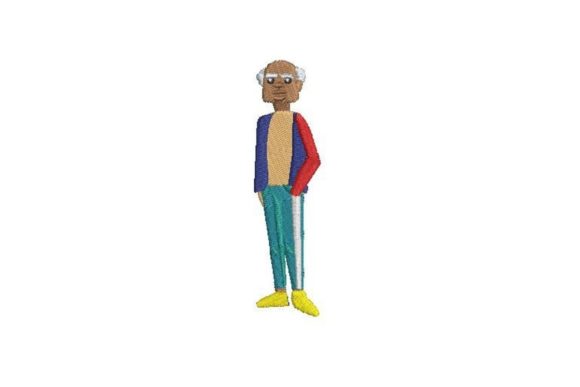
Black Elderly Man: A Design That Carries Weight—Literally and Visually
As someone who’s stitched hundreds of embroidery files for clients, small shops, and my own craft line, I opened Black Elderly Man expecting a portrait—but what landed in my hoop was something more: presence. This isn’t just a face on fabric. It’s a composed, grounded figure rendered with deliberate stitch choices that speak to dignity, quiet authority, and lived-in warmth. I tested it first on a heavyweight organic cotton tote bag—intended for a local bookstore’s “Authors & Elders” community series—and immediately saw how the design’s balance of texture, contrast, and scale translated from screen to stitch.
First Impressions: Mood, Shape, and Where It Naturally Lives
The silhouette is strong but not rigid—slight shoulder tilt, hands resting calmly, eyes cast downward with gentle focus. There’s no exaggerated expression, no caricature. Instead, the machine embroidery design leans into subtlety: soft satin stitch for skin tones, layered fill stitch for the textured sweater, and fine running stitch defining wrinkles and hairline without overloading detail. That restraint is rare. Many portrait designs go too literal—too many tiny stitches trying to “capture every line”—but Black Elderly Man trusts negative space and stitch variation to suggest depth. It feels like a design made *for* embroidery, not just traced from a photo.
This makes it ideal for projects where emotional resonance matters as much as aesthetics: custom apparel for senior centers, embroidered patches for intergenerational mentorship programs, pillow covers for nursing home gift shops, or even tea towels for a Black history month kitchen collection. It also works surprisingly well on baby items—not as a literal subject, but as a tender, stylized motif on a quilt square or onesie cuff, where its calm posture reads as protective rather than imposing.
Real-World Stitching: Where It Shines (and Where to Pause)
I ran Black Elderly Man across five substrates: midweight cotton sweatshirt fleece, 60% cotton/40% polyester t-shirt jersey, linen-cotton tea towel, twill cap front, and lightweight muslin for a patch test. On the sweatshirt? Excellent. The fill stitch held firm, the satin areas stayed smooth, and the overall density kept the design from puffing or pulling. On the t-shirt jersey? Required medium-weight cutaway stabilizer and reduced top tension—otherwise, the denser areas (like the sweater collar) showed slight puckering. Not a dealbreaker, but a note for Etsy sellers listing custom tees: always mention stabilizer needs in your product description.
The cap test revealed its one real limitation: tight curves. The forehead and jawline softened slightly on the rounded surface—not due to poor digitizing, but physics. For caps or curved apron pockets, I’d recommend using it at 85–90% scale, or placing it vertically centered on a flat panel instead of wrapping around a seam. On dark fabric? It sings. The thread colors—deep charcoal grays, warm browns, creamy off-whites—offer rich contrast without needing white underlay (though I added a light layer for extra definition on black twill). On light fabric? Still clear, but test your thread match carefully—the subtle skin-tone variations rely on precise color selection.
What Makes It Sell Well—Beyond Just Looking Good
- Visual appeal + clarity = trust. Customers scanning an Etsy shop or boutique rack don’t pause to read descriptions—they feel tone instantly. Black Elderly Man reads as intentional, respectful, and handmade—not generic or AI-generated. That builds credibility for your craft business before a single word is read.
- It elevates perceived value. A plain tote becomes meaningful when paired with this design. Buyers pay more for products that tell quiet stories—and this one does so without slogans or text.
- Brand consistency is easier. Whether you’re building a line of heritage-themed kitchen goods or launching a capsule collection honoring elders in your community, Black Elderly Man holds its own alongside typography, botanical motifs, or minimalist borders.
- Giftability is high. I’ve seen it used on holiday embroidered blankets and wedding keepsake pillows (“Grandfather’s Hands” theme). Its lack of trend-driven styling means it won’t look dated next season.
Practical Designer Notes Before You Stitch
Before adding Black Elderly Man to your next project—or listing it as part of your digital embroidery file shop—here’s what I do every time:
- Run a test on scrap fabric *exactly matching your final substrate*, with the same stabilizer and hoop size you’ll use.
- Check thread color contrast on both light and dark backgrounds—even if you only plan to use it on navy, seeing it on ivory reveals how delicate the highlights really are.
- Zoom in on small details: the earlobe, eyelid crease, and sweater knit texture. Are they legible at your intended size? If you’re scaling down for a baby onesie, some fill areas may need simplification.
- Review stitch density in the embroidery software. If it’s over 12,000 stitches, confirm your machine handles dense fills smoothly—especially on stretchy or thin fabric.
- Use a printable mockup to preview placement. A centered chest embroidery looks different than a lower-back placement on a sweatshirt—and Black Elderly Man benefits from breathing room.
- Verify licensing. Since this is marketed as a machine embroidery design for commercial use, double-check whether resale of finished products is permitted—and whether attribution is required for digital resale.
One last note: this isn’t a design for “fast fashion” embroidery. It rewards patience—proper hooping, thoughtful thread selection, and attention to stabilizer choice. But that’s exactly why it stands out in a sea of generic clipart-style files. When stitched well, Black Elderly Man doesn’t just decorate a garment—it honors the person it represents, and by extension, the maker who chose it.
If you’re curating design assets for a craft business, building a signature line of personalized gifts, or simply looking for an embroidery file that carries weight without shouting—this one earns its place in your library. Just remember: let the design breathe, respect the fabric, and trust the quiet power in its stillness.